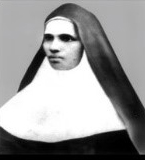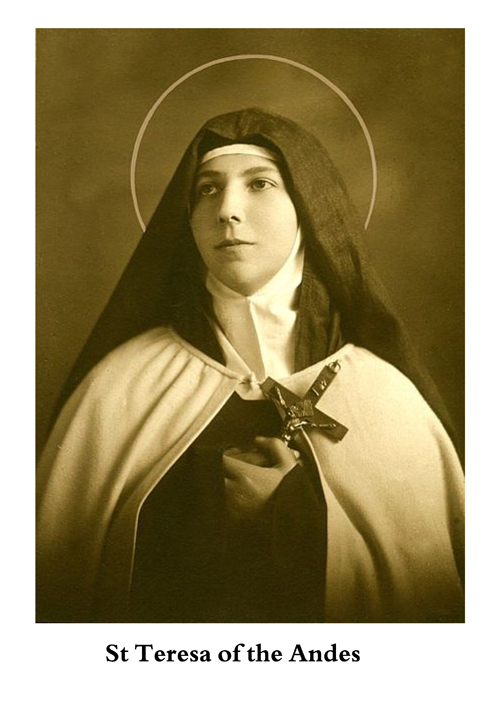
 St. Teresa of the Andes, born as Juana Fernandez Solar in 1900,
entered the Carmelite Order at 19, driven by an intense desire to
unite with Christ. Her short life was marked by deep spiritual
maturity and a profound interior relationship with God. From a
young age, Teresa felt called to a life of prayer, sacrifice, and
devotion, realizing that the truest happiness lay in surrendering
herself to Christ. She often described herself as being “consumed by
God,” her spirit seeking not earthly pleasures but the fullness of
divine love.
At the heart of Teresa’s spirituality was her deep devotion to the
Eucharist and the Passion of Christ. For her, the Eucharist was a
continual source of strength and a place where she encountered the living Christ. She believed
that in offering her life in love and suffering, she was intimately participating in the redemptive
mission of Jesus. Her love for Christ was so personal and consuming that she longed to suffer
with Him, seeing suffering as the gateway to eternal union with God.
Teresa’s life was a journey toward simplicity and humility. She modeled her interior life on St.
Thérèse of Lisieux’s “little way,” seeking holiness through small, everyday acts of love and
sacrifice. She found God in the ordinary and embraced the Carmelite way of silence and solitude
with joy. Through these simple acts, she believed she was bringing grace not only to her own
soul but to the entire world.
What sets Teresa apart is the depth of her mystical experiences. Even before entering the
convent, she encountered the presence of Christ in visions and inner locutions. Her prayer life
was marked by ecstasies and a profound awareness of God’s presence in her soul. She
frequently spoke of her “spiritual marriage” to Christ, expressing her total abandonment to His
will. For Teresa, this union was both her mission and her salvation, one she embraced until her
untimely death at age 19 due to typhus.
Her writings reveal a young woman entirely consumed by divine love, whose heart beat solely
for God. In her letters, she constantly encouraged others to seek God above all things and to
offer their lives as acts of love. Her spirituality was deeply Eucharistic, Marian, and Carmelite,
rooted in a theology of total surrender and a desire for sanctification.
Despite her brief time on earth, Teresa of the Andes’ life offers a profound example of youthful
sanctity, showing that the pursuit of holiness and intimate communion with God is not restricted
by age. Her life was a beacon of light, a testament that true joy and peace are found in living
fully for Christ. Through her witness, Teresa invites all to seek God in the depths of the heart,
offering their lives as a gift of love in return for His boundless grace.